
13×6 Lace Front Wigs Wholesale: Improving Lace, Hairlines and Durability
When buyers search for 13×6 lace front wigs wholesale, they are looking for more than a larger lace area or an attractive product photo. For salons, distributors, e-commerce brands, and private-label businesses, the real value of a 13×6 lace front wig lies in how naturally the lace blends, how realistic the hairline looks, how flexible the parting space is, and how well the unit performs after repeated wear and styling.
At Honsen Source Hair, we focus on continuously improving lace construction, hairline design, craftsmanship, and product durability to address common problems in the lace wig industry. The goal is simple: develop wholesale 13×6 lace front wigs that provide a more natural appearance while maintaining practical durability and consistent manufacturing quality.
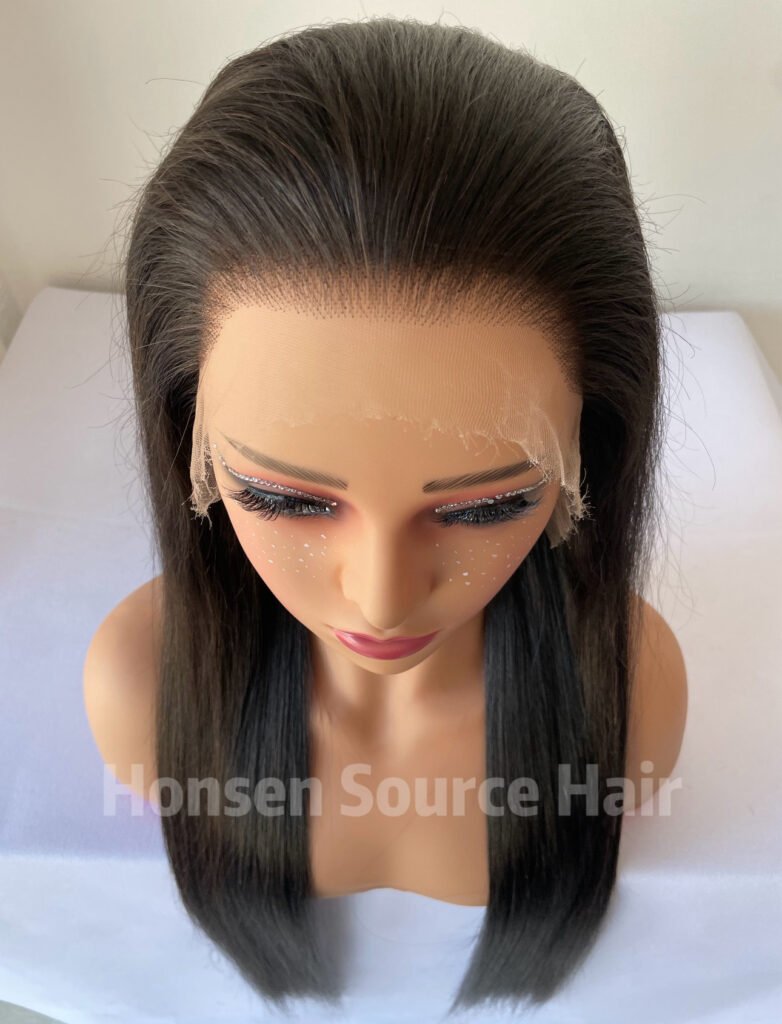
Why 13×6 Lace Front Wigs Require Careful Engineering
The 13×6 lace design provides a relatively large lace area from ear to ear and toward the crown, giving wearers more flexibility when creating different parting styles.
However, a larger lace area also creates higher requirements for manufacturing.
The lace needs to remain sufficiently lightweight while providing structural stability. The hairline needs to look natural across a wider area. Ventilation and hair density must be controlled carefully, and the cap needs to maintain a secure and comfortable fit.
If these elements are not properly coordinated, buyers may experience common problems such as:
- Visible lace edges
- An overly uniform hairline
- Excessively dense frontal hair
- Weak or damaged lace
- Uncomfortable cap construction
- Excessive shedding
- Tangling after repeated styling
- Inconsistent quality between production batches
For a wholesale manufacturer, solving these problems requires continuous process improvement rather than relying on a single production technique.
1. Continuously Improving Lace Construction
Lace is one of the most visible components of a lace front wig.
Thick or poorly constructed lace can make the wig appear less natural, while overly delicate lace may become difficult to handle during installation and daily wear.
This creates a manufacturing challenge: the lace needs to provide a natural appearance while maintaining enough structural integrity for practical use.
Honsen Source Hair focuses on improving lace quality as part of its broader product development approach. Its current product range includes HD lace front wigs and 13×6 lace wigs, with the company emphasizing lightweight, natural-looking lace and detailed craftsmanship.
For wholesale buyers, this balance is important because lace quality affects both the customer’s first impression and the product’s usability.
Our approach is to evaluate lace from several perspectives rather than treating “thin lace” as the only quality standard.
The key considerations include:
- Lace transparency
- Softness and flexibility
- Hair ventilation
- Edge appearance
- Structural strength
- Compatibility with customization
- Overall wearing comfort
The objective is to create lace that supports a realistic appearance without unnecessarily sacrificing durability.
2. Creating More Natural Hairline Designs
A realistic hairline is one of the most important features of a premium lace front wig.
Even high-quality human hair can look artificial if the hairline is too straight, too dense, or overly uniform.
Natural hairlines contain variations in density and direction. The transition from the forehead to the hair should therefore appear gradual rather than forming an obvious straight boundary.
This is why hairline design requires careful ventilation and finishing.
Honsen Source Hair emphasizes natural and invisible hairline effects across its human hair wig collection, while its 613 HD lace product includes a pre-plucked hairline designed to create a more natural transition.
For our 13×6 lace front wigs wholesale products, hairline development focuses on creating a more realistic transition while preserving enough density for customers who want to customize the unit further.
This balance matters to B2B buyers because different end customers have different preferences. Some want a ready-to-wear natural hairline, while others want additional room for customization.
3. Improving Ventilation and Hair Density
Hair density is closely connected to hairline realism.
Too much density around the frontal area can make the wig appear bulky. Too little density can make the hairline look sparse or create unwanted gaps.
Professional ventilation therefore requires both technical consistency and craftsmanship.
During production, manufacturers need to consider the relationship between:
lace area → knot placement → hair direction → density → hairline transition.
These elements cannot be treated as completely separate processes.
For a 13×6 unit, the larger lace area makes this particularly important because customers may create different parting positions. The hair needs to fall naturally from different directions while maintaining a realistic scalp effect.
This is one reason why experienced craftsmanship remains important even when a manufacturer has standardized large-scale production.
4. Addressing the Durability Challenge
Natural appearance is only one part of product quality.
Wholesale buyers also need products that can withstand normal handling, installation, styling, cleaning, and repeated wear.
Durability can be affected by several factors, including:
- Raw hair quality
- Lace construction
- Knot strength
- Ventilation technique
- Cap construction
- Chemical processing
- Heat styling
- Daily maintenance
Honsen Source Hair’s website highlights virgin human hair with intact cuticles and positions this material as a foundation for durability, reduced tangling, and longer service life when properly maintained.
This is particularly relevant for B2B buyers because product durability can affect customer satisfaction, repeat purchases, and return rates.
A supplier should therefore evaluate durability from the beginning of the manufacturing process instead of treating it as an issue that can be solved through after-sales instructions alone.
5. Combining Natural Appearance With Practical Strength
One of the industry’s recurring challenges is that some improvements can create trade-offs.
For example, thinner lace may improve the visual effect but require more careful handling. A very dense hairline may create a fuller appearance but look less natural. Extremely soft hair may feel luxurious but still needs appropriate processing and construction to perform well during repeated use.
The solution is not to maximize one individual specification.
Instead, manufacturers need to optimize the entire product.
For Honsen Source Hair, this means considering raw hair quality, lace, hairline design, density, construction, finishing, and quality inspection as connected parts of the same product development process.
This philosophy also applies to HD lace front wigs wholesale, where lace quality and natural hairline construction are particularly important to the final customer experience.
6. Making 13×6 Wigs Easier to Customize
One advantage of the 13×6 construction is its versatility.
A larger lace area can provide more space for different parting styles and personalized looks. For salons and private-label brands, this flexibility can make the product suitable for a broader customer base.
However, customization should begin with a well-constructed base unit.
A quality 13×6 wig should provide an appropriate foundation for:
- Middle parts
- Side parts
- Different styling directions
- Hairline customization
- Baby-hair customization
- Cutting and restyling
- Color changes where appropriate
The 613 blonde human hair wig available from Honsen Source Hair is an example of a 13×6 HD lace product designed around human hair, styling versatility, and customization. The product page highlights 100% human hair, HD lace, pre-plucked hairline construction, and the ability to cut, curl, and dye the hair.
For wholesale buyers, this versatility can make it easier to build different product offerings around one core construction.
7. Quality Control Is Essential for Wholesale Orders
Improving a product is only valuable if the improvements can be reproduced consistently.
This is particularly important for 13×6 lace front wigs wholesale because B2B buyers may order dozens or hundreds of units.
A supplier needs to ensure that the approved sample and mass-produced products remain within the agreed specifications.
Quality checks may include:
Lace Inspection
Checking lace appearance, construction, edges, and visible defects.
Hairline Inspection
Checking density, hair direction, pre-plucking, and overall natural appearance.
Hair Quality Inspection
Checking texture, length, shedding, tangling, and overall condition.
Cap Inspection
Checking dimensions, stitching, straps, combs, and structural components.
Final Product Inspection
Checking the finished unit against the approved sample before packaging and shipment.
Honsen Source Hair’s OEM/ODM process includes sample confirmation, mass production supervision, quality inspection, and shipment, while its stated core advantages include strict quality inspection for every batch and full-process tracking.
This process is particularly valuable for wholesale customers who need consistent products rather than isolated high-quality samples.
8. Solving Common Problems Before They Reach the Customer
A strong manufacturer should not wait for customers to report problems before improving a product.
For example, if buyers frequently encounter unnatural lace edges, the manufacturer can investigate lace construction and finishing.
If hairlines appear too dense, ventilation and pre-plucking procedures can be reviewed.
If customers report excessive shedding, raw material quality, knot construction, and production handling can be evaluated.
If products become difficult to maintain after repeated wear, manufacturers can examine the relationship between hair quality, processing, construction, and care instructions.
This continuous feedback loop turns customer experience into product-development information.
It is also why Honsen Source Hair continues to develop its lace wig product range rather than treating an existing design as permanently finished.
Common 13×6 Lace Front Wig Problems We Aim to Address
Problem 1: Visible Lace
Poor lace quality or incorrect installation can make the lace edge noticeable.
Our focus: improve lace selection and construction to support a more natural blending effect.
Problem 2: Unnatural Hairlines
Straight, overly dense hairlines can make a wig look artificial.
Our focus: improve ventilation, density transitions, and pre-plucked hairline design.
Problem 3: Limited Styling Flexibility
A poorly constructed lace area can restrict parting and styling options.
Our focus: use the 13×6 structure to provide greater customization space.
Problem 4: Excessive Shedding and Tangling
Poor-quality raw hair and weak construction can reduce product performance.
Our focus: select appropriate human hair materials and control production quality.
Problem 5: Inconsistent Wholesale Batches
A sample may look excellent while later production differs.
Our focus: use sample confirmation and batch-level quality inspection to create clearer production standards.
What Wholesale Buyers Should Look for in a 13×6 Wig Supplier
Before choosing a supplier, B2B buyers should evaluate more than the product photograph.
Ask the manufacturer:
- What type of human hair is used?
- What lace material is available?
- How is the hairline constructed?
- Is the hairline pre-plucked?
- What density options are available?
- Can the lace and cap be customized?
- How is sample quality maintained during mass production?
- What quality inspection is performed before shipment?
- Can the supplier support OEM or ODM orders?
- Can the supplier provide trial orders before larger purchases?
These questions help buyers evaluate whether the supplier has an actual manufacturing and quality-control system rather than simply reselling finished products.
For more information about customized manufacturing, buyers can also review Honsen Source Hair’s OEM/ODM customization service, which covers product development, sampling, mass production, quality inspection, and shipment.
Continuous Improvement Is the Foundation of Better Lace Wigs
The development of a better 13×6 lace front wig does not end when a product is launched.
Customer expectations continue to change. Buyers want more natural hairlines, more comfortable lace, greater styling flexibility, stronger products, and more consistent wholesale quality.
Manufacturers therefore need to continue reviewing raw materials, construction methods, ventilation, hairline design, quality inspection, and customer feedback.
For Honsen Source Hair, continuous improvement means looking at the complete product rather than focusing on one feature.
A thinner lace is useful, but it also needs appropriate strength.
A natural hairline is important, but it should still provide sufficient density for customization.
High-quality human hair is essential, but it needs to be combined with appropriate construction and finishing.
And excellent craftsmanship matters, but it must be supported by a production and quality-control system capable of handling wholesale demand.
Honsen Source Hair: Developing Better 13×6 Lace Front Wigs
For businesses sourcing 13×6 lace front wigs wholesale, the right manufacturing partner should provide more than attractive samples.
The supplier should understand the common problems faced by retailers, salons, distributors, and end customers—and continuously improve its products to address them.
Honsen Source Hair focuses on human hair wigs and related products, including 13×6 lace wigs, HD lace front wigs, human hair bundles, and other wholesale hair products. The company’s current product and service information emphasizes virgin human hair, detailed craftsmanship, customization, batch quality inspection, and international wholesale cooperation.
Our approach is centered on continuous improvement in three areas: lace quality, natural hairline design, and product durability.
If you are looking for a reliable supplier for 13×6 lace front wigs wholesale, we can discuss your preferred lace type, hair density, length, color, cap specifications, customization requirements, sample needs, and bulk order plans.
Phone / WhatsApp: +86 18854297087
Email: sales@honsensource.com
Location: Qingdao, Shandong, China
Author & Publishing Information
Author: Honsen Source Hair Editorial Team
Reviewer: Honsen Source Hair Team
Published: September 19, 2026
Last Updated: September 19, 2026
Contact: +86 18854297087
Email: sales@honsensource.com